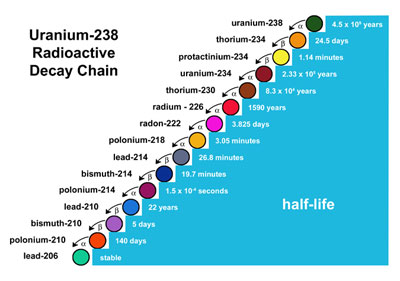
Tuesday, January 24, 2012

Group Commercial (2 or 3 people max) DUE FRIDAY at beginning of class

Your goal will be two-fold.

First, synthesize the information from yesterday in some digital format and share it with me. I will need at least 2 points or sentences for each one of the topics.   Additionally, add any information your find about the topic below to your digital document, including your RESOURCES.

Secondly, create a video public service announcement that tells the class about one of the following.  I would prefer you spread out across all the topics, rather than several people doing the same thing.


  • Irradiation of spices using cobalt-60
  • Cs-133 atomic clock uses
  • Iodine-131 uses
  • Americium-241 for gauging plastic
  • Americium-241 smoke detectors
  • CT vs. PETscans using C-11, N-13, or O-15
  • Uses of Technicium-99m
  • Fresh food irradiation using cobalt-60 to kill ecoli or other bacteria.
The following information must be present in your video clip:
a.  What type of decay is going on?
b.  What is the half-life of the object, and how long will it take for 99% to disappear
c.  How can we protect humans from this type of isotope when we don't want to be exposed to it?
d. Are quarks involved in this process?
e. Is this process used currently?
f.  How is the technology like a particle detector.   Pick two similarities and two differences.
g. Why is radioactivity all around us?   And what's the difference between radioactivity and antimatter.

Upload your video to a youtube account and share with me.

Grading Rubric

Content correctness:  10 points
Entertainment value:  10 points
Use of media to enhance presentation: 5 points
Involvement by all members of group:  5 points
Title or Credits, as appropriate:  5 points.

Text or tweet me with questions.

Day 10: Where Now?

We still haven't figured out the mechanism of a beta decay. Why is it that an ELECTRON would fly out of the nucleus? The answer involves quarks.


A quark is found inside of protons or neutrons. When a quark becomes unstable, a neutron can turn into a proton. To keep charges balanced, an electron also comes ripping out.


BUT YOU DON'T HAVE TO TAKE MY WORD FOR IT.... Instead, check out this website to find out about:
quarks

  • the standard model
  • antimatter
  • particle detectors
  • how particle detectors work
  • how this benefits science
  • how this benefits society
Gather all this information into a digital document (a Linoit or Google Doc is suggested) and include any questions you still have.

Thursday, January 19, 2012

Day 7-8 Radioactivity Types

Nuclear Checkers


The Battleship Detector

Rutherford's Experiment Connections


Day 9: Revisiting the Models

Let's start with a look at the BIG Questions.  What comments can you add now?

Take a look at four of the public service videos that your class made.   What are some of the strengths and weaknesses you see?   How do we get people to buy a message that we are sending? Write your thoughts on a whiteboard.


Class Conversation

Individual Problems


  • An object taken from a cave has a carbon-14 fraction which is 0.89 of the amount in a
living organism. How old is the object? (half-life for C-14 is 5730 yr)

  • Write nuclear equations for the following processes:
    a. Ra-226 decays by α-emission.
    b. The result of the β-decay of an isotope is Mg-22.

  • For the following, calculate the value of time elapsed for four half-lifes ofthe isotope:
    a. Th-227, 18.2 day
    b. Pa-234, 6.75 hr
    c. Rn-222, 3.823 day

  • The half-life of Pa-234 is 6.75 hr. How much (what fraction) of a sample of this isotope remains after 20.25 hr?
  • The half-life of Rn-222 is 3.823 day. What was the original mass of a sample of this isotope if 0.0500 g remains after 7.646 day?

Sunday, January 15, 2012

Day 6: Problems

Your goal is to try to answer the problems found below.  For each one you can use a hand-drawn chart like this one, or the table that is attached, but you MUST show your logic for each project.  Just writing down the answer will not get you credit.


1) The half life of iodine-131 is 8.040 days. What percentage of an iodine-131 sample will remain after 40.2 days?
2) The half-life of thorium-227 is 18.72 days How many days are required for three-fourths of a given amount to decay?
3) If you start with 5.32 x 10⁹ atoms of Cs-137, how much time will pass before the amount remaining is 5.20 x 10⁶? The half-life of Cs-137 is 30.17 years.
4) The half-life of the radioactive isotope phosphorus-32 is 14.3 days. How long until a sample loses 99% of its radioactivity?
5) U-238 has a half-life of 4.46 x 10⁹ years. How much U-238 should be present in a sample 2.5 x 10⁹ years old, if 2.00 grams was present initially?   (Hand this in individually)

Part 2:  Radon.  Radon is a big problem in Iowa, and the videos we watched in the last post point this out.   Design some sort of a Public Service Announcement that will highlight this concern to people in Iowa, why it is dangerous, and what they can do about it.

Part 3:  Radioactive Dating as a Group

Radioactive Dating Game
Click to Run


Use the applet above to complete as much as you can with your group of this document   Save it to a Google Docs folder and share it with me.

Thursday, January 12, 2012

Wednesday, January 11, 2012

Day 2: Radioactivity Models

  • Reading 1
  • MM/Skittle Models
  • Enter and Share Data on Google Spreadsheets
  • Read pp. 618-619 in book


  • Class discussion


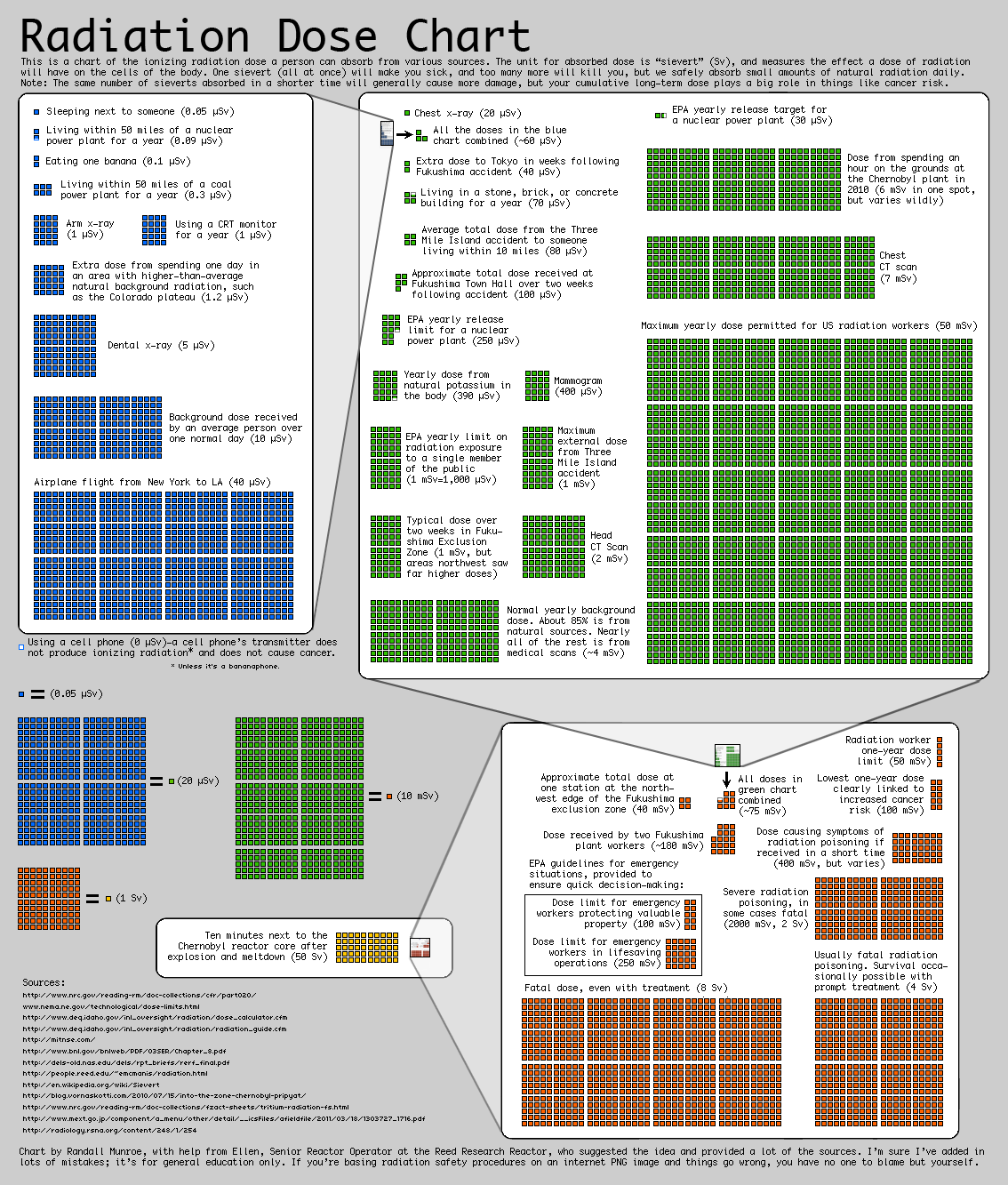
http://imgs.xkcd.com/blag/radiation.png