Tuesday, January 11, 2011


Monday, January 10, 2011
Thursday, January 6, 2011
Radioactivity Primer
FINDING OUT ABOUT THE NUCLEUS
Thomsen's Experiment
Rutherford's Model
Chadwick and Millikan
RADIATION AND PROBABILITY
The Basics
The Dosages and Such
Thomsen's Experiment
Rutherford's Model
Chadwick and Millikan
Watch the full episode. See more NOVA.
The Basics
The Dosages and Such
Tuesday, January 4, 2011
What is a Detector?
Today, we talked about rules and detectors. Sometimes detectors are inadequate for us to find all the rules. What we do in physics mirrors that. We need to collect enough data, using appropriate detectors, to help us fill out the rules.
Wednesday, December 22, 2010
Marshmallow Catapults
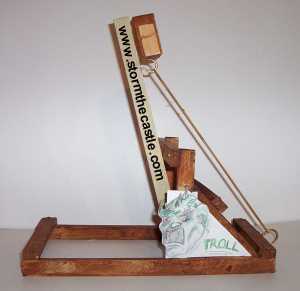
Trebuchet Project
Benchmark on Projectile and Rotary Motion
Build a trebuchet that is capable of launching a large marshmallow from a distance of 3 to 5 meters, and hitting a target that is .30 m high +/- .10 m. You will have 5 trials to hit your target, and will be graded according to your building design, accuracy, and analysis.
Questions for Analysis
(To be completed individually)
- Where is the biggest frictional issue in your machine? Explain why this matters to the momentum of the mallow.
- Determine the maximum range for your trebuchet, t(calc), and the initial values of v(x) and v(y) including a diagram using logger pro
- How could you determine F(net) of the mallow?
- How will the momentum of the projectile change if we use jawbreakers instead of marshmallows? An orange? Why?
- Pick a time frame for your catapult. Determine the change in t, the acceleration due to gravity, and the distance traveled. Based on this, calculate v(i) at the beginning of the interval and v(f) at the end of the interval in the x and the y directions. Choose your interval carefully so you are not mixing y(up) and y(down)
- Write a three to five paragraph summary of how you would change the design if you built another machine, and what you have learned about physics. Include the following terms: potential energy, kinetic energy, frictional force, net force, acceleration of gravity, vector errors, kinematic equations, independent x and y motions.
Wednesday, November 3, 2010
STATICS
Reflection on Bridge Building
- How much did your bridge hold?
- How much did it cost, and how did you minimize your costs?
- What is the mass of your bridge?
- Calculate the force weight of the bridge, and the force weight of the load applied.
- Calulate a ratio to show me the strength of the bridge (load/bridge)
- Using the member data sheet, which bridge member held the greatest load? How do you know?
- Can a member experience both compression and tension? Explain.
- IS your bridge model a good fit for the bridge you made in the program? Why or why not?
- Draw a force diagram for your bridge when the truck is on the left-hand side of the structure.
- How does friction matter in this project?
- What have you learned in this project about statics, force diagrams, angles, and vectors.
This entire sheet should be 1-2 pages long, hand-written or typed, and due on Monday, November 8.
Subscribe to:
Posts (Atom)